
Frequently asked questions
Getting started
Section titled “Getting started”For which roles can I use ama?
Section titled “For which roles can I use ama?”You can use ama for any white-collar role, from specialist and manager positions up to senior leadership. The one requirement is that the target group is well represented on LinkedIn, since that is where ama sources profiles. Roles with little or no LinkedIn presence — for example blue-collar positions, doctors, veterinarians, nurses and care workers, or teachers — are not a good fit.
Who can use ama?
Section titled “Who can use ama?”ama is built for hiring managers, recruiters, and talent teams at companies and recruiting agencies who work on active sourcing. It is used collaboratively, allowing multiple stakeholders to work together on the same TMM.
How does the process work?
Section titled “How does the process work?”- You share any information you have with us: a job description, company information, and so on.
- We will set everything up and then can have a meeting a few hours later to share first results, look at candidates, and discuss any refinements.
Can I change the specified criteria of a TMM?
Section titled “Can I change the specified criteria of a TMM?”Not yet, but coming soon. Until then, please reach out to your value engineering team.
Scoring & assessment
Section titled “Scoring & assessment”How are the criteria for a Talent Market Map defined?
Section titled “How are the criteria for a Talent Market Map defined?”The criteria are defined based on your or your colleagues’ input. Either a job description was uploaded or the role specifications were defined together with ama in a kickoff call. Based on this, ama translates the requirements into structured, role-specific criteria that are used to build the TMM.
How does a profile receive a qualification score of A?
Section titled “How does a profile receive a qualification score of A?”A profile gets an A score when ama identifies it as an excellent fit for the role, meaning the candidate strongly matches the key skills, experience, and comes from a highly relevant context (for example industry, company type, and seniority). The motivation assessment is not considered for the qualification score.
How does ama’s motivation assessment work?
Section titled “How does ama’s motivation assessment work?”ama estimates how likely a candidate is to change jobs based on professional signals in their profile and career history, such as time in the current role, company growth, visible career progression, company size fit, estimated salary change, seniority vs. the role level, and (for on-site roles) whether relocation would be realistic — while not assessing private or personal motivations that are not visible from the CV.
What is an archetype?
Section titled “What is an archetype?”An archetype is a predefined candidate profile that represents a common career pattern for a role. It groups typical backgrounds, skills, and experience paths (e.g. “Scale-up Account Executive” or “Enterprise Sales Manager”) and helps ama evaluate and compare candidates consistently against the role requirements.
Where does the salary estimation come from?
Section titled “Where does the salary estimation come from?”ama estimates salary based on information from the candidate’s profile, such as role, seniority, experience, location, and company context, combined with current market benchmarks.
How does ama ensure the responsible use of AI?
Section titled “How does ama ensure the responsible use of AI?”ama uses AI to support hiring decisions — not to make them. All final decisions stay with humans. Every assessment is explainable and granular: each score comes with clear reasons down to individual criteria, so you can see exactly why a candidate was ranked a certain way and adjust the criteria if needed.
Candidates & data
Section titled “Candidates & data”How often is a candidate’s profile updated?
Section titled “How often is a candidate’s profile updated?”Typically once a month. Often candidates wait a few months after starting a new job until they update their CV.
Why can’t I see a candidate from ama on LinkedIn?
Section titled “Why can’t I see a candidate from ama on LinkedIn?”LinkedIn profiles can change their public URL or visibility settings. When this happens, older links may lead to an empty or unavailable page. We’re actively working on improving link reliability.
Can I import my inbound applicants to a TMM?
Section titled “Can I import my inbound applicants to a TMM?”Yes — see the guide Adding profiles to a talent map.
Can I download the talent list into a CSV or Excel file?
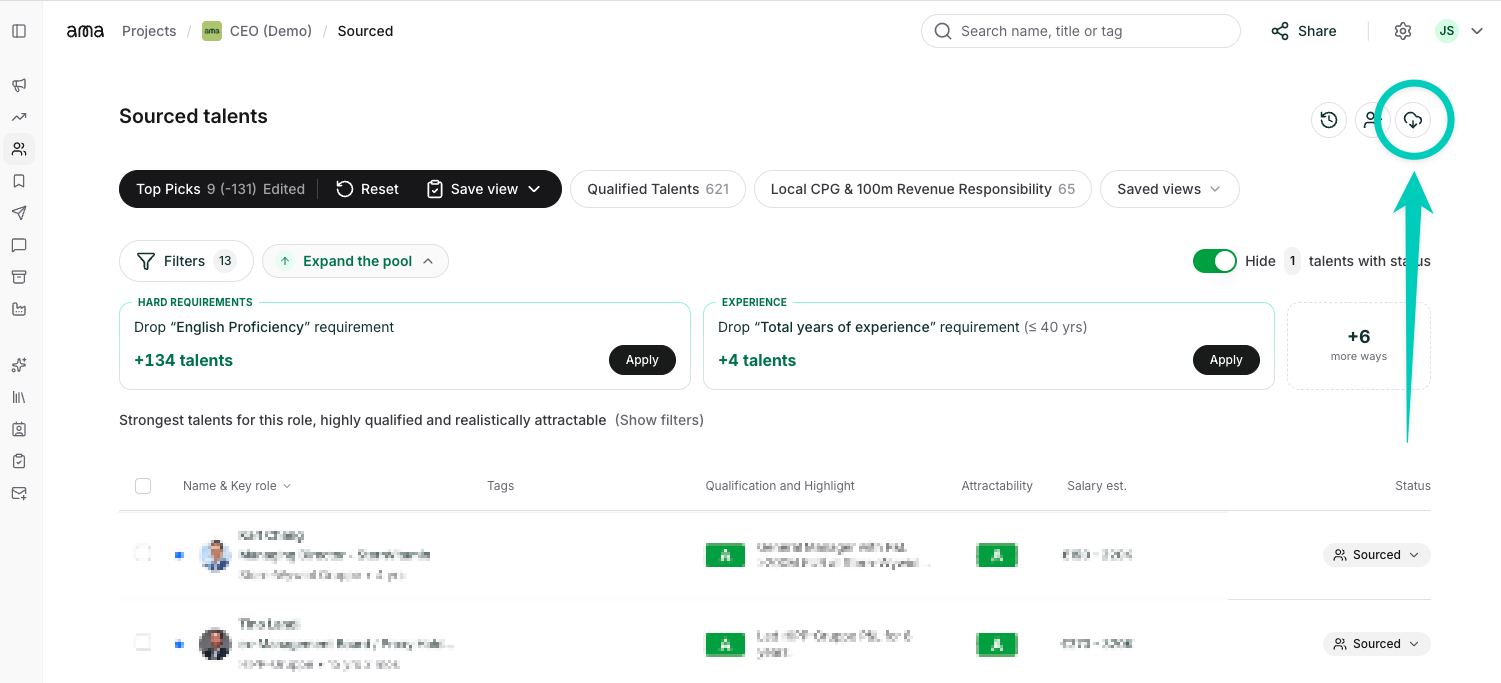
Section titled “Can I download the talent list into a CSV or Excel file?”Yes, absolutely. Use the export (download) icon in the top-right corner of the talent list, and ama exports exactly the talents in the view you’re currently looking at:
- In the shortlist, it exports the shortlist.
- In sourced talents, it exports the sourced talents.
- To export everyone, first open Qualified talents — or All talents under saved views — and then export.
Integrations & outreach
Section titled “Integrations & outreach”Does ama integrate with my ATS?
Section titled “Does ama integrate with my ATS?”Not yet, but coming soon.
Does ama also reach out to candidates?
Section titled “Does ama also reach out to candidates?”Yes. ama can support candidate outreach with personalized, role-specific messaging.